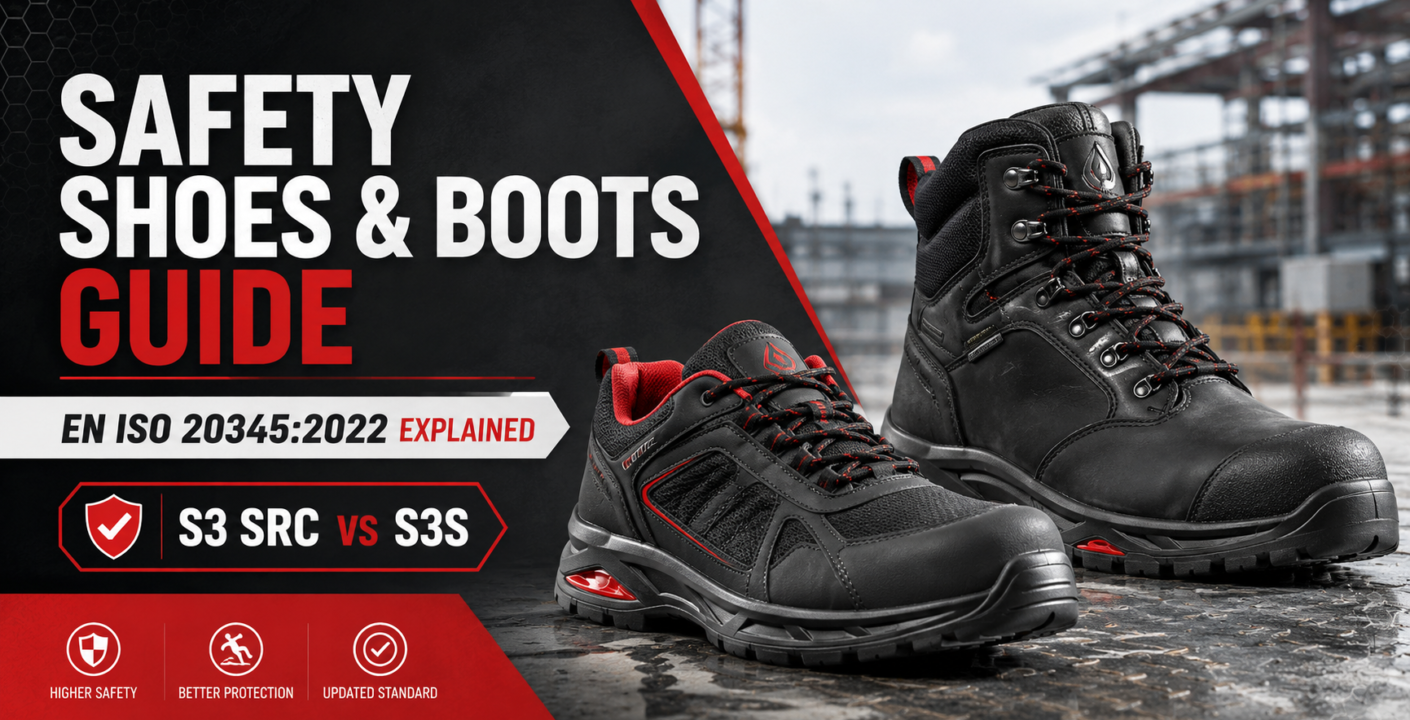
Safety Shoes & Boots in Lebanon: EN ISO 20345:2022, S3S, SR and the New Safety Ratings Explained
Choosing the right safety shoes in Lebanon is about much more than selecting a steel-toe shoe or work boot.
Modern safety footwear can protect workers against falling objects, punctures, slippery floors, water, heat, cold, electrostatic discharge and other workplace hazards. However, understanding the markings printed on a safety shoe — such as S1P, S3, S3S, SR, HRO, ESD or WPA — can sometimes be confusing.
This has become even more important since the introduction of EN ISO 20345:2022, which changed several classifications that were commonly used under the previous EN ISO 20345:2011 standard.
For example, many workers and purchasing managers were familiar with seeing:
S3 SRC
on a safety boot.
Today, newer certified footwear may instead be marked:
S3S SR
or:
S3L SR
So what changed?
In this guide, we explain the main types of safety shoes and safety boots, what EN ISO 20345 means, the difference between the 2011 and 2022 standards, and how to understand the latest safety footwear markings.
What Is EN ISO 20345?
EN ISO 20345 is one of the main international standards governing safety footwear used in professional environments.
ISO describes ISO 20345 as the standard specifying basic and additional requirements for safety footwear, covering areas including mechanical risks, slip resistance, thermal risks and ergonomic behaviour.
One of the most recognizable requirements of EN ISO 20345 safety footwear is the protective toe cap.
Safety footwear certified under EN ISO 20345 is designed with a safety toe cap capable of protecting the toes against significant impact.
This does not necessarily mean the toe cap must be made from steel.
Modern safety shoes can use:
- Steel toe caps
- Aluminum toe caps
- Composite toe caps
- Fiberglass toe caps
- Nano-carbon or other non-metallic toe-cap technologies
The material may change, but certified footwear must still meet the applicable performance requirements of the standard.
This is why lightweight, sporty-looking safety sneakers can provide certified toe protection just like traditional industrial safety boots.
Why Did EN ISO 20345 Change From 2011 to 2022?
The previous ISO 20345:2011 edition was published in December 2011 and has since been withdrawn and replaced by ISO 20345:2021. The European adoption is commonly referenced as EN ISO 20345:2022.
Safety standards are periodically reviewed and updated as footwear technology, materials, testing methods and workplace requirements evolve.
The 2022 version introduced important changes particularly concerning:
- Slip resistance
- Puncture-resistant midsoles
- Waterproof footwear
- Water penetration and absorption
- Fuel and oil resistance
- Scuff-cap protection
- Ladder grip
- Safety footwear classifications
Safety Jogger, for example, notes that the previous 2011 standard was in place until June 2022, when the updated standard came into effect.
These changes allow safety footwear markings to communicate more precisely how the footwear was tested.
EN ISO 20345:2011 vs EN ISO 20345:2022
Some of the biggest changes can be summarized as follows:
| EN ISO 20345:2011 | EN ISO 20345:2022 |
|---|---|
| SRA / SRB / SRC slip ratings | Basic slip test + optional SR |
| P for puncture resistance | P, PL or PS depending on insert/test |
| S1P | S1P / S1PL / S1PS |
| S3 | S3 / S3L / S3S |
| WRU | WPA |
| No S6 category | S6 introduced |
| No S7 category | S7 introduced |
| Fuel/oil resistance commonly incorporated into classifications | FO is now an additional marking |
| No SC marking | SC introduced |
| No LG marking | LG introduced |
Understanding these differences is particularly important when comparing an older safety shoe certificate with a newly certified model.
Is S3 SRC Now S3S?
This is one of the most common questions regarding the new standard.
The short answer is:
Not exactly.
An older safety boot may have been certified:
S3 SRC
while a newer model with comparable applications may be marked:
S3S SR
However, S3S and SRC describe different properties.
Under EN ISO 20345:2011, SRC concerned slip resistance.
Under EN ISO 20345:2022, the S in S3S concerns puncture resistance, specifically the test applied to a non-metallic puncture-resistant insert.
Slip resistance is treated separately.
This distinction is extremely important.
What Happened to SRC Slip Resistance?
Under EN ISO 20345:2011, there were three commonly recognized slip-resistance markings:
SRA
The shoe was tested on ceramic tile with a detergent-type solution.
SRB
The shoe was tested on a steel surface with glycerol.
SRC
The footwear passed both the SRA and SRB requirements.
SRC therefore became a very popular marking on industrial safety footwear.
Under EN ISO 20345:2022, this system changed.
A slip-resistance test using a ceramic surface with a soap solution became part of the basic requirement for safety footwear, so there is no additional marking for passing that basic test.
An additional slip-resistance test using ceramic flooring and glycerin may also be performed.
Footwear that meets this additional requirement receives the marking:
SR
Safety Jogger confirms that SRA, SRB and SRC were used under the 2011 system, while under the 2022 standard the ceramic-floor soap test forms part of the basic requirement and the additional test is identified by SR.
Therefore:
SRC did not simply get renamed SR.
The test methodology itself changed.
This is why comparing an old SRC shoe directly with a new SR shoe solely from the letters can be misleading.
What Does S3S Mean on Safety Shoes?
This is one of the most important changes under EN ISO 20345:2022.
Under the older standard, puncture-resistant safety footwear was commonly identified using:
P
The newer standard distinguishes between different types of puncture-resistant inserts and test nail sizes.
The principal markings are now:
P — Metallic Puncture-Resistant Insert
P is used for metallic puncture-resistant inserts.
PL — Non-Metallic Insert, 4.5 mm Nail Test
PL identifies a non-metallic puncture-resistant insert tested using a 4.5 mm nail.
PS — Non-Metallic Insert, 3.0 mm Nail Test
PS identifies a non-metallic puncture-resistant insert tested using a smaller 3.0 mm nail.
The smaller nail presents a different and demanding penetration challenge for textile and other non-metallic anti-puncture materials.
Safety Jogger summarizes the new system as:
- P: metallic midsole
- PL: non-metallic midsole tested with a 4.5 mm nail
- PS: non-metallic midsole tested with a 3 mm nail
This explains the new classifications:
S1P / S1PL / S1PS
and:
S3 / S3L / S3S
S3 vs S3L vs S3S Safety Shoes
This is especially relevant when buying construction safety shoes or safety boots in Lebanon.
S3
In the new classification system, S3 footwear can use a metallic puncture-resistant insert meeting the applicable P requirement.
S3L
S3L footwear uses a non-metallic puncture-resistant insert complying with the PL test using a 4.5 mm nail.
S3S
S3S footwear uses a non-metallic puncture-resistant insert complying with the PS requirement using the smaller 3 mm nail.
So when you see:
S3S SR
you are learning two different things about the footwear:
S3S tells you about its protection class and puncture-resistant system.
SR tells you that it passed the additional slip-resistance requirement.
That is much more informative than assuming the complete marking simply replaced “S3 SRC.”
Main Safety Shoe Classes Explained
When searching for safety shoes in Lebanon, you may encounter several protection classes.
Here is a simplified guide.
SB Safety Shoes
SB represents the basic safety footwear requirements.
This category includes the fundamental safety-toe protection required by EN ISO 20345.
It can be suitable for environments where toe protection is necessary but additional features such as puncture resistance or water resistance are not required.
S1 Safety Shoes
S1 safety shoes add several protective characteristics beyond the basic requirements.
They are commonly used for indoor workplaces such as:
- Warehouses
- Logistics centers
- Factories
- Assembly operations
- Workshops
- Maintenance operations
Because S1 footwear does not primarily target wet outdoor environments, it is particularly popular for indoor industrial applications.
S1P, S1PL and S1PS Safety Shoes
When puncture protection is added to the S1 category, you may encounter:
S1P
Metallic puncture-resistant insert.
S1PL
Non-metallic puncture-resistant insert tested according to the PL requirement.
S1PS
Non-metallic puncture-resistant insert tested according to the PS requirement.
These categories are especially useful where workers may step on nails, metal pieces or other sharp objects.
S2 Safety Shoes
S2 adds resistance to water penetration and absorption of the upper.
It can therefore be more appropriate than S1 for environments where occasional moisture or water exposure is expected.
However, there is an important difference between a water-resistant upper and a completely waterproof safety shoe.
That distinction became clearer with the introduction of S6 and S7.
S3, S3L and S3S Safety Shoes
S3-type footwear is among the most commonly used safety footwear for demanding work environments.
It combines the characteristics expected from the preceding classes with puncture protection and outsole characteristics intended for more demanding workplaces.
Typical applications include:
- Construction
- Civil engineering
- Contracting
- Heavy industry
- Mechanical work
- Outdoor maintenance
- Warehouses
- Infrastructure projects
- Industrial facilities
For many companies looking for safety boots in Lebanon, S3-type footwear is therefore one of the first categories considered.
Depending on the puncture-resistant insert, newer footwear can be classified as:
S3
S3L
or:
S3S
What Are S6 Safety Shoes?
Another major change in EN ISO 20345:2022 was the introduction of:
S6
S6 helps identify footwear that combines an S2-type protection level with WR protection for the complete footwear.
This is particularly useful because buyers can distinguish between footwear with a water-resistant upper and footwear designed and tested for greater overall water protection.
Safety Jogger describes S6 as corresponding to S2 WR footwear.
For workers exposed to rain and wet environments, this distinction can be very important.
What Are S7 Safety Shoes and Boots?
S7 represents a higher-protection waterproof category incorporating characteristics associated with S3-type footwear together with whole-footwear water resistance.
Safety Jogger describes S7 as corresponding to S3 WR footwear.
Depending on the puncture-resistant insert and certification, you may encounter classifications such as:
S7
S7L
S7S
These categories are particularly interesting for:
- Outdoor construction
- Infrastructure projects
- Utilities
- Wet industrial environments
- Winter work
- Workers regularly exposed to rain or standing water
For Lebanon, this can be particularly relevant for outdoor workers during the rainy winter season.
WRU Has Changed to WPA
Another marking that purchasing managers may recognize from older safety shoes is:
WRU
Under the newer EN ISO 20345 system, WRU has been replaced by WPA.
WPA refers to testing for:
Water Penetration and Absorption
It concerns the footwear upper.
Safety Jogger confirms that shoes with water-resistant uppers are now marked WPA under the newer standard.
It is important not to confuse:
WPA — water penetration and absorption properties of the upper
with:
WR — water resistance of the complete footwear.
For workers exposed to significant amounts of water, this distinction should be considered carefully.
What Does FO Mean on Safety Shoes?
FO means:
Fuel Oil Resistance
It indicates that the outsole has been tested for resistance to fuel oil.
One notable change under EN ISO 20345:2022 is that this is no longer automatically treated as a mandatory requirement in the same way as before.
If the footwear meets the relevant fuel-oil resistance requirement, it is identified with:
FO
This allows purchasers to determine whether oil and hydrocarbon resistance is actually relevant to the footwear they are considering.
FO can be particularly useful for:
- Mechanics
- Automotive workshops
- Industrial maintenance
- Oil and gas environments
- Machinery operations
What Does SC Mean?
The newer standard also introduced:
SC — Scuff Cap Abrasion
SC identifies footwear whose scuff-cap area meets an additional abrasion-resistance requirement.
A scuff cap is especially useful for workers who frequently kneel during their work.
For example:
- Construction workers
- Electricians
- Flooring installers
- Maintenance technicians
- Plumbers
Repeated kneeling can quickly damage the front upper of ordinary safety footwear.
A durable scuff cap can therefore significantly improve the practical service life of a safety shoe.
SC is listed among the additional features introduced with the newer standard.
What Does LG Mean?
LG relates to:
Ladder Grip
This additional marking is particularly useful for workers regularly working with ladders.
The outsole design must provide appropriate characteristics for ladder use according to the applicable test requirements.
LG may therefore be particularly relevant for:
- Electricians
- Telecommunications technicians
- Maintenance workers
- Construction workers
- Industrial technicians
- Utility workers
LG is another additional feature introduced with the updated safety-footwear system.
Other Common Safety Shoe Markings
EN ISO 20345 safety shoes can carry several additional markings depending on their design and intended application.
Common examples include:
HRO — Heat Resistant Outsole
HRO footwear is designed for applications requiring resistance to contact heat at the outsole.
This can be useful in demanding industrial applications, road works, welding-related environments and hot surfaces where appropriate.
CI — Cold Insulation
CI indicates additional insulation against cold.
It can be useful for workers in cold environments, refrigerated areas or outdoor winter conditions.
HI — Heat Insulation
HI concerns insulation against heat through the sole complex.
ESD — Electrostatic Discharge
ESD footwear is designed to control electrostatic discharge within defined resistance parameters.
It is particularly important in environments such as:
- Electronics manufacturing
- Sensitive industrial facilities
- Laboratories
- Certain clean rooms
- Operations involving electrostatic-sensitive equipment
ESD should not automatically be confused with electrical-insulating footwear. They are designed for different risks and applications.
Steel Toe vs Composite Toe Safety Shoes
Another common question when choosing safety shoes or safety boots is whether steel toe or composite toe protection is better.
Both can be used in certified safety footwear when the complete footwear successfully meets the applicable requirements.
Steel Toe Caps
Advantages can include:
- Excellent impact protection
- Traditional and proven construction
- Competitive pricing
- High durability
Composite Toe Caps
Advantages can include:
- Lower weight
- Metal-free construction
- Better convenience around metal detectors
- Reduced thermal conductivity compared with steel
Modern composite safety shoes can therefore be particularly attractive for workers who spend long hours walking or standing.
The important factor is not simply whether a toe cap is steel or composite.
The important question is:
Is the complete safety shoe properly certified for the intended workplace risk?
Safety Shoes vs Safety Boots: Which Should You Choose?
Both low-cut safety shoes and safety boots can provide excellent workplace protection.
The correct choice depends on the job.
Low-Cut Safety Shoes
Often preferred for:
- Warehouses
- Logistics
- Factory work
- Drivers
- Light industry
- Indoor maintenance
Advantages can include greater flexibility, lower weight and a more athletic feel.
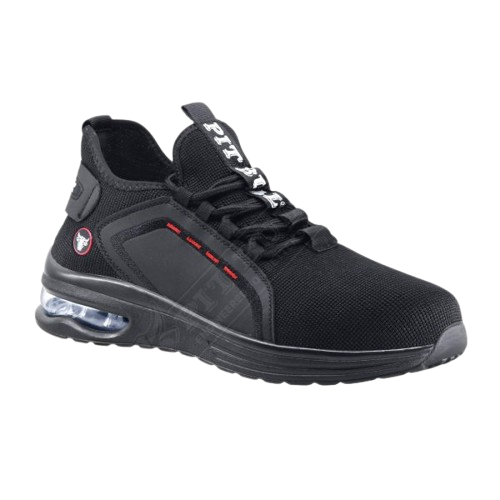
Modern safety sneakers can now look very similar to ordinary running shoes while incorporating protective toe caps, puncture-resistant midsoles and slip-resistant outsoles.
Mid-Cut Safety Shoes
Mid-cut designs provide additional coverage around the ankle while remaining relatively lightweight.
They can provide a useful balance between mobility and support.
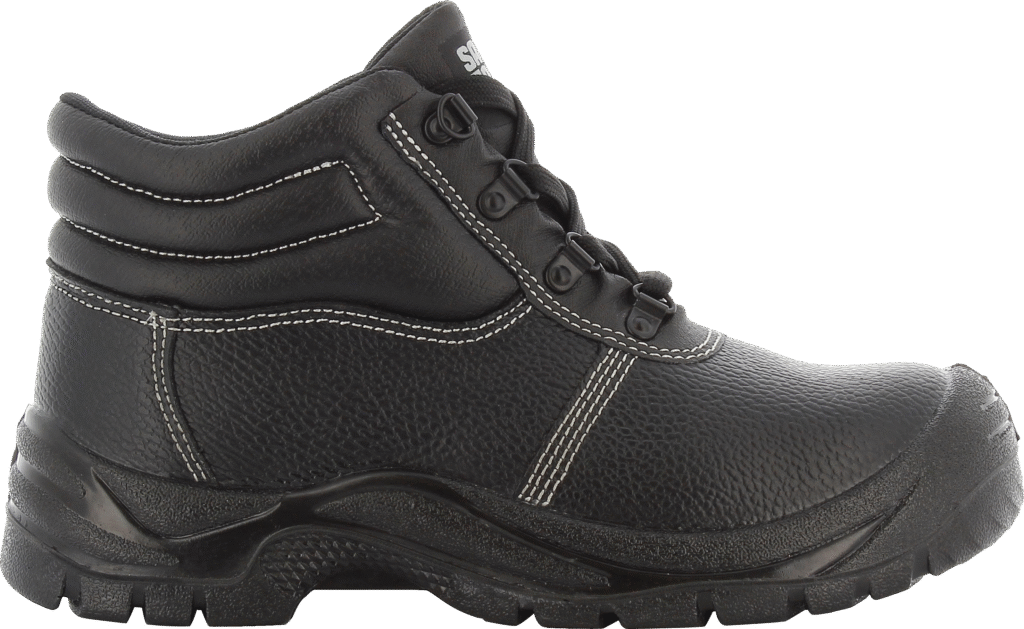
Safety Boots
Safety boots are often preferred for:
- Construction
- Heavy industry
- Outdoor work
- Infrastructure
- Mechanical environments
- Wet or muddy conditions
- Demanding contracting work
The additional upper coverage may provide better protection and support depending on the working conditions.
What Safety Shoes Are Best for Construction?
There is no single safety shoe that is best for every construction worker.
The correct footwear should be selected according to the actual workplace risk assessment.
However, construction environments commonly require consideration of:
- Toe protection
- Puncture resistance
- Slip resistance
- Water resistance
- Outsole durability
- Scuff resistance
- Ladder grip
- Heat resistance
- Ankle support
This is why S3, S3L and S3S safety shoes and boots are frequently selected for construction and contracting applications.
Additional ratings such as SR, SC, LG, HRO, CI or WR may also be appropriate depending on the work environment.
Which Safety Shoes Should Companies in Lebanon Choose?
When buying safety shoes in Lebanon, companies should avoid selecting footwear based only on price or appearance.
Consider the actual work environment.
Warehouses and Logistics
Look at lightweight S1-type footwear or puncture-resistant S1P/S1PL/S1PS models where necessary.
Construction
S3-type footwear is often more appropriate, particularly where puncture hazards and outdoor conditions exist.
Mechanical Garages
Consider slip resistance, fuel-oil resistance and durable outsoles.
Outdoor Work
Water resistance and outsole grip become increasingly important.
Electronics and Sensitive Environments
ESD footwear may be necessary.
Heavy Industrial Work
A combination of puncture protection, robust toe protection, outsole durability and additional properties such as HRO may be required.
Ultimately, the correct certification should correspond to the hazards identified for the job.
EN ISO 20345:2022+A1:2024 — What Does the A1 Mean?
Buyers may now also see newer safety footwear marked:
EN ISO 20345:2022+A1:2024
This does not mean EN ISO 20345:2022 has disappeared.
An amendment to ISO 20345:2021 was published in January 2024, and European/UK standards listings now identify the corresponding amended version as EN ISO 20345:2022+A1:2024 or its national equivalent.
This is normal in standards development.
Standards can receive amendments containing technical or editorial changes without requiring an entirely new edition.
For buyers, the most important point is to check the actual certification and Declaration of Conformity supplied with the footwear rather than judging a shoe only by marketing terminology.
Are EN ISO 20345:2011 Safety Shoes Still Safe?
Seeing EN ISO 20345:2011 on a shoe does not automatically mean that the product suddenly became unsafe when the standard changed.
Existing certification does not simply disappear the day a revised standard is introduced.
Safety Jogger notes that certificates issued under EN ISO 20345:2011 remain valid until their certificate expiration.
This explains why the market went through a transition period in which both 2011-certified and newer 2022-certified footwear could be encountered.
For new purchases, however, understanding the latest classifications makes it much easier to compare modern footwear correctly.
Frequently Asked Questions About Safety Shoes
What does S3S mean in safety shoes?
S3S identifies S3-type safety footwear using a non-metallic puncture-resistant insert meeting the PS puncture requirement, which includes testing using a 3 mm nail.
Is S3S better than S3?
Not necessarily in every situation.
The classifications identify different puncture-resistant systems and tests.
S3 traditionally identifies footwear using a metallic puncture-resistant insert, while S3S identifies a non-metallic insert tested according to the PS requirement.
The correct choice depends on the workplace, footwear design and required protection.
Is S3 SRC the same as S3S?
No.
SRC was a slip-resistance classification under EN ISO 20345:2011.
The final S in S3S concerns the newer PS puncture-resistance classification.
A newer shoe might be marked S3S SR, but S3S itself should not be described as the direct replacement for SRC.
What replaced SRC safety shoes?
The old SRA/SRB/SRC system was changed under EN ISO 20345:2022.
A basic ceramic-floor slip test is now incorporated into the requirements, while footwear passing the additional applicable slip-resistance test can be marked SR.
What is the difference between S3L and S3S?
Both use non-metallic puncture-resistant inserts.
S3L corresponds to the PL requirement involving a 4.5 mm test nail.
S3S corresponds to the PS requirement involving a smaller 3 mm test nail.
What is the difference between WPA and WR?
WPA concerns water penetration and absorption of the footwear upper.
WR concerns water resistance of the footwear as a whole.
Are composite safety shoes certified?
Yes.
Safety footwear does not need a steel toe cap simply because it is certified to EN ISO 20345.
Composite and other non-metallic toe caps can be used provided the complete footwear meets the applicable certification requirements.
Choosing Certified Safety Shoes in Lebanon
Understanding the difference between S1P, S1PL, S1PS, S3, S3L, S3S, SR, WPA, WR, HRO, ESD and other markings helps companies select footwear according to actual workplace hazards rather than simply choosing a product labelled “safety shoe.”
The transition from EN ISO 20345:2011 to EN ISO 20345:2022 did more than rename existing classifications.
It introduced more detailed distinctions for puncture-resistant midsoles, changed the slip-resistance testing and marking system, introduced new waterproof categories and added new optional performance markings.
For procurement managers, contractors, engineers and safety officers, understanding these ratings makes it easier to choose the right safety footwear for each application.
Looking for Safety Shoes and Safety Boots in Lebanon?
SUM SARL supplies professional safety shoes and safety boots in Lebanon for construction, industrial, logistics, maintenance, mechanical and general workplace applications.
Our range includes different protection classes and technologies, including steel-toe and composite-toe footwear, puncture-resistant safety shoes, lightweight safety sneakers, industrial safety boots, ESD footwear and water-resistant models.
Whether you require footwear for a construction project, factory, warehouse, mechanical workshop or corporate safety program, choosing the correct certification is essential.
Browse our range of safety shoes in Lebanon or contact SUM SARL for assistance selecting the appropriate safety footwear for your workplace requirements.