

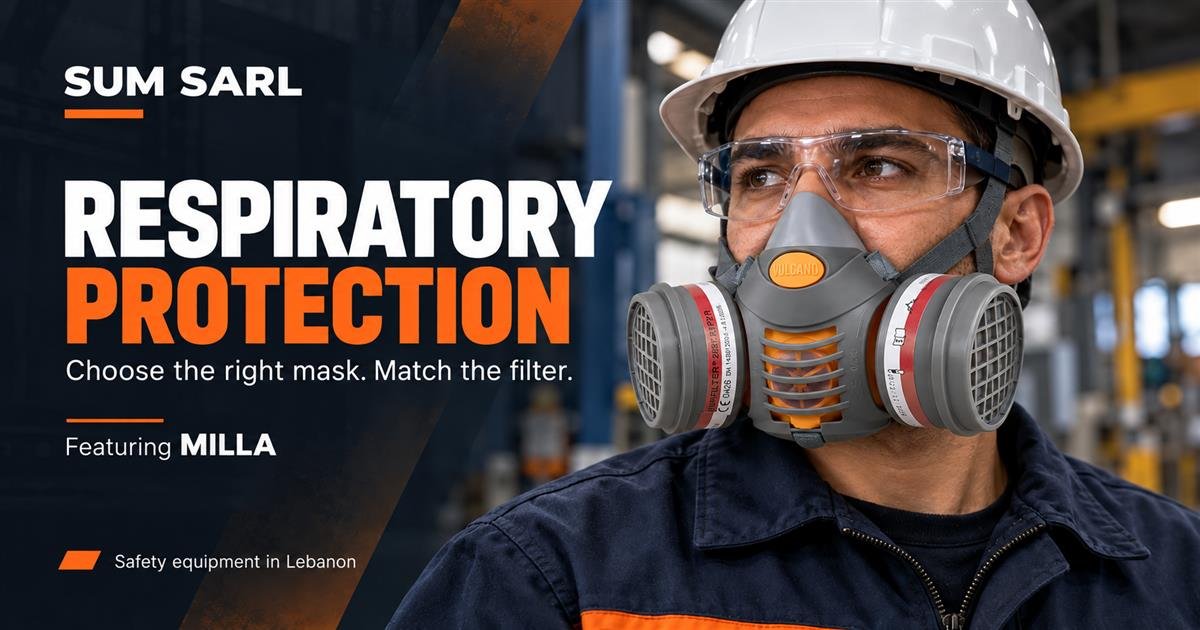
Respiratory protection is an essential part of workplace safety. Whether your team works in construction, woodworking, painting, agriculture or industrial maintenance, the air around them may contain contaminants that require careful assessment and suitable protective equipment.
Some hazards are visible, such as clouds of dust. Others, including certain gases and vapours, may be present without an obvious warning. Selecting the right respirator means understanding the task, identifying the contaminants and choosing equipment that provides the required protection.
At SUM SARL, we supply MILLA respiratory protection in Lebanon, including reusable half-face respirators, full-face respirators, disposable particulate masks, compatible filters and accessories. Our collection gives businesses and professionals several options for building a suitable respiratory protection system.
Why Is Respiratory Protection Important?
Airborne hazards can enter the body through breathing. Depending on the substance, concentration and duration of exposure, they can cause irritation or contribute to serious health problems. Protecting workers starts with reducing exposure at its source and addressing the conditions that allow contaminants to enter the breathing zone.
Measures such as safer processes, dust extraction, enclosure and appropriate ventilation should come first. Where a workplace assessment identifies a remaining respiratory risk, suitable respiratory protective equipment provides an additional layer of protection. This approach follows the hierarchy of controls described by NIOSH.
A respirator must match the hazard. A mask intended for dust will not automatically protect against solvent vapours, and a gas filter will not necessarily protect against airborne particles. Correct selection is just as important as wearing the equipment consistently.
Common Workplace Uses for Respiratory Protection
Construction and Renovation
Cutting, drilling, sanding and handling building materials can release airborne dust. The required protection depends on the material being worked on, the process and the level of exposure. Tasks involving hazardous dusts require particular attention to extraction, exposure assessment and the specified level of respiratory protection.
Woodworking and Furniture Production
Sawing, machining and sanding wood can create airborne particles. Finishing operations may introduce additional hazards from coatings, adhesives or solvents. A workshop may therefore need different filter configurations for different tasks rather than one mask-and-filter combination for every operation.
Painting and Surface Finishing
Painting can involve both airborne droplets and chemical vapours. Selecting equipment requires reviewing the coating, application method and safety data sheet. A gas-only cartridge does not provide particulate protection against spray mist. Some coatings and exposure conditions require specialist equipment beyond a filtering respirator.
Agriculture and Crop Treatment
Agricultural work may involve dust or chemical exposure during preparation, application, cleaning and maintenance. Respiratory protection must follow the requirements of the specific product label, safety data sheet and workplace assessment. An agriculture-labelled kit should never be assumed suitable for every pesticide or treatment.
Industrial Maintenance and Manufacturing
Cleaning, grinding, chemical handling and equipment maintenance can create different respiratory hazards within the same facility. Identifying the substances and exposure conditions helps determine whether particulate filtration, gas filtration, combined filtration or another form of respiratory protection is needed.
Discover MILLA Respiratory Protection at SUM
Our MILLA collection includes several respirator formats and two distinct reusable filter connection systems. This allows customers to compare equipment according to their work requirements, preferred configuration and compatible replacement filters.
Start with the hazard, then select the mask and filter together. Comfort, maintenance and replacement-filter planning also matter when equipping an individual worker or an entire team.
MILLA VULCANO 2000 Half-Face Respirator
The MILLA VULCANO 2000 is a reusable half-face respirator with two quick bayonet filter connections. Its soft TPE facepiece and adjustable harness support individual fitting, while side-mounted filters distribute the filter weight on either side of the face.
The mask accepts compatible MILLA Series 2000 and Series 2500 Compact filters. It requires two matching filters selected for the identified exposure. Its reusable construction makes cleaning, inspection and replacement of serviceable components part of routine ownership.
MILLA EURMASK DIN 7355 Half-Face Respirator
The MILLA EURMASK DIN 7355 offers a single-filter configuration with a DIN RD40 threaded connection. It is designed for use with suitable MILLA Series 7000 filters and features a soft facepiece with an adjustable harness.
This model uses a different connection system from the VULCANO 2000. When ordering a mask or replacement cartridge, confirming the connection and approved compatibility helps avoid purchasing components that cannot be used together.
MILLA 7100 Full-Face Respirator
The MILLA 7100 Full-Face Respirator features a panoramic polycarbonate visor, a flexible TPE face seal and a four-point adjustable harness. Its twin bayonet connections accept compatible MILLA filters.
A full-face format may be specified where the task requires this type of respiratory equipment and face coverage. Selection still depends on the assessed exposure, approved filter combination and correct fit. Confirm whether filters are supplied when ordering.
MILLA MA105V FFP2 Valved Dust Mask
For tasks where an FFP2 particulate respirator is appropriate, our MILLA MA105V FFP2 Valved Dust Mask provides a disposable option. It has a cup-shaped facepiece, adjustable nose clip, elastic head straps and an exhalation valve.
Its classification is FFP2 NR D. The NR marking indicates single-shift use, while D identifies completion of the additional dolomite-dust clogging test. This model filters particles; it does not provide protection against gases or vapours.
MILLA VULCANO 2000 Agriculture Respirator Kit 2042
The MILLA Agriculture Kit 2042 brings together a VULCANO half-face respirator, an A1B1E1K1-P2 R filter configuration, Pantor goggles and a portable carry case.
Keeping the equipment together is convenient for transport and organisation between work areas. This is the Agriculture 1 configuration with P2 filtration; suitability must be checked against the chemicals and exposure conditions of the task.
Understanding Respirator Filters
The facepiece and filter work as a system. Choosing a comfortable mask is only one part of the decision: the filter must also address the contaminants present and be approved for that respirator.
MILLA 2593 A2 Bayonet Filter
The MILLA 2593 A2 is a gas filter for suitable organic gases and vapours with boiling points above 65°C. It is used in pairs on compatible MILLA bayonet respirators.
A2 alone does not provide protection against dust, fumes or spray mist. Where particles are also present, the complete approved filter configuration must address both hazards.
MILLA 7020 A2 RD40 Gas Filter
The MILLA 7020 A2 provides an A2 gas-filter option with a DIN RD40 screw connection. In our collection, it is an option for the EURMASK DIN 7355 when the identified organic vapours and working conditions suit this filter class.
The 7020 RD40 cartridge and 2593 bayonet cartridge use different connections. They are not interchangeable simply because both carry an A2 classification.
MILLA 2595 A1B1E1K1P3 R Combined Filter
The MILLA 2595 A1B1E1K1P3 R combines filtration for specified gas groups with P3 particulate filtration. It is intended for paired installation on compatible MILLA bayonet respirators.
This classification covers defined categories of contaminants rather than every gas or chemical. Selection must account for the actual substances, concentrations and manufacturer limitations. The R marking does not mean that the filter has unlimited service life.
MILLA 7599 Respirator Prefilter Kit
The MILLA 7599 Prefilter Kit is an accessory for specified compatible MILLA filter assemblies. It is not a complete respirator or a standalone substitute for selecting the correct filter.
Before adding a prefilter, confirm the approved cartridge, retaining components and protection rating of the complete assembly.
How to Choose Respiratory Protection for Your Workplace
- Identify the contaminants. Determine whether the task involves particles, gases, vapours or a combination. Review the relevant safety data sheets.
- Assess the exposure. Consider concentration, task duration, ventilation and working conditions. Use competent occupational safety advice where needed.
- Select the required equipment. Establish the protection level and whether a filtering respirator is appropriate for the environment.
- Confirm compatibility. Match the facepiece, filters and accessories using the manufacturer’s approved configurations.
- Check individual fit. Choose a model that seals correctly to the wearer’s face and arrange fit testing for tight-fitting respirators.
- Plan ongoing use. Include training, inspection, cleaning, storage and a suitable filter replacement schedule.
Filtering respirators do not supply oxygen. They must not be used in oxygen-deficient atmospheres or relied on for unknown or immediately dangerous conditions. Such environments require specialist assessment and appropriate respiratory equipment.
Correct Fit Is Essential
A suitable filter cannot deliver its expected protection if contaminated air leaks around the face seal. Tight-fitting respirators need fit testing to establish whether the selected model and size fit the individual wearer. Facial hair crossing the sealing area can interfere with that seal.
A user seal check must also be performed every time the respirator is put on, following the manufacturer’s procedure. This daily check serves a different purpose from a fit test and does not replace it. See NIOSH guidance on respirator fit testing for further information.
Workers should also check how the respirator interacts with their other protective equipment. Eyewear, helmets and other items must be worn without disrupting the face seal or preventing correct positioning.
Maintenance, Storage and Filter Replacement
Reusable respirators need regular care to remain serviceable. Before use, inspect the facepiece, harness, valves, connections and filters. Follow the manufacturer’s instructions for cleaning and replacing approved components.
- Clean reusable facepieces using the specified method.
- Store equipment in a clean, dry location protected from contamination and damage.
- Check expiry dates and packaging condition before fitting new filters.
- Replace particulate filters according to the instructions, including when damaged or when breathing resistance increases.
- Replace gas and combined cartridges according to an established change-out schedule; do not rely on smell as the replacement indicator.
- Replace disposable respirators within their stated use limits and sooner if their condition or fit deteriorates.
For team use, assigning responsibility for inspections, replacement supplies and worker training helps keep respiratory protection available and ready when required.
Frequently Asked Questions
Can one respirator protect against every airborne hazard?
No. Protection depends on the complete respirator system, filter type, exposure conditions and correct use. No single filter should be treated as suitable for every dust, gas or vapour.
Is an FFP2 mask suitable for solvent vapours?
No. The MA105V FFP2 is a particulate respirator. Solvent vapours require equipment selected for the specific chemical hazard, and some tasks may require a different type of respiratory protection altogether.
Can I use the same filters on every MILLA mask?
No. Our collection includes bayonet and RD40 threaded systems. Always check the exact mask model, filter connection and manufacturer-approved combination before ordering or fitting replacements.
Does the agriculture kit protect against every pesticide?
No. The Kit 2042 has a defined A1B1E1K1-P2 R configuration. Its suitability must be checked against the pesticide label, safety data sheet and assessed exposure.
Where can I find MILLA respirators and filters in Lebanon?
You can explore the MILLA collection at SUM SARL for respirators, filters, kits and accessories. Our product pages include specifications and available technical documentation to support your selection.
Equip Your Team with MILLA at SUM SARL
Effective respiratory protection starts with understanding the work and selecting a complete, compatible system. Correct fit, worker training and ongoing maintenance help turn that equipment into a dependable part of everyday safety.
At SUM SARL, we help customers explore MILLA product options using the manufacturer’s specifications and their workplace requirements. Whether you need disposable particulate masks, reusable half-face respirators, full-face equipment or replacement filters, our collection provides a practical starting point.
Explore MILLA respiratory protection at SUM or call us on +961 81 887 731 for product inquiries, availability and company quotations.